Showing posts with label word problems. Show all posts

Saturday, August 20, 2016

Using Math Fails for Critical Thinking

What's the Problem?

Here is a scary statistic, up to 60% of our STEM (science, technology engineering, math) majors in college end up dropping out...because of math. There are lots of theries on why this is happening. They go from  grade inflation, to students not receiving a good foundation. However, there is another theory that seems much more likely to me! That theory says that math is taught in the United States as a series of problems that have a specific method to reach the right answer. The goal is a perfect grade. That's not how life works! It's not how science works, and it certainly isn't how engeneering or technology work! Math is actually problem solving. A 100% on a test doesn't mean a student can figure out a real life problem that involves math.

Who's Succeeding?

Kids who take part in math clubs and competitions learn how to solve peroblems they have never seen before. Instead of looking at math as something to do to get a perfect score, it's solving problems for the pure joy of finding the solution. That gives kids real pleasure, and a feeling of accomplishment. That's especially true when it takes a few days (weeks) to puzzle over a problem and finally find the solution. Back to the kids who were in math clubs and competitions, they seem to survive the change from high school to college math much better than kids who were at the top of their math class, but never took part in the clubs or competitions. It seems the "tyranny of 100%" caused these new freshmen to give up too easily when they didn't do well. The truth is, if a kid is getting 98% or 100% in math all of the time, it's too easy.


What Can Elementary Teachers Do?

Math thinking takes time. The skills students need to solve complex problems, break them down into small parts and approach from many angles without getting frustrated takes time and practice to build. That has to start in the elementary grades.

There are tons of ways to give problems to kids that are real puzzlers, but a great way to start in second through fourth grade is with pictures. A fun way all kids love, is finding mistakes adults make. Sometimes it takes a lot of thinking to even realize there is a problem! Give your students one of these pictures before math class begins, and allow students to struggle with it. Some will get it right away, others will have to think.  That's good! Ask students to write down their answers and keep them to themselves. Print out the picture, so you can keep it up all day. Some students will puzzle over it. That's good too. The next day, discuss the answer and how students came to solve the problem.  That discussion helps students who struggle to learn stategies.


Need some fun resources to add to your math curriculum?  Check out:


Tuesday, January 19, 2016

End Word Problem Panic!


If there is one thing that can tie kids in a knot, it's word problems. You know there's a problem when you mention the term "word problem" and everyone in your class gets that "deer in headlights" look. It doesn't have to be that way. With some easy to follow steps, and a little practice, you can help your students cut word problems down to size.

The first thing to do is calm their fear. I told my students that a word problem is like a puzzle. All it takes is a few simple steps to cut them down to size, and solve the puzzle. Let's look at steps that can make those word problems super simple.

Steps for Making Word Problems Make Sense: 


1. Read the problem twice: don't skimp on this one! Many times people think they know what to do after reading it once, but when they read it again they find out they are mistaken. If students can restate the problem in their own words, that helps too.
    Teaching hint: I like to have students get into pairs once they have read the problem twice and discuss how to say it in their own words together. It only take a couple of minutes.

2. Dicide which sentence tells what the problem is asking you to figure out. Underline that sentence.

3. Decide what information in the problem will help you figure out the answer.
    Teaching hint: It's import for students to know how to disregard information that is thrown in there to trick them. It's also a necessary skill when taking standardized tests.

4. Dicide on a strategy to help you visualize the problem using only the needed information. Some strategies to consider are:  make a picture, make a table, guess and check, use logical reasoning, work backwards, find a pattern.
     Teaching hint: This is the step that doesn't use an equation. Instead it encourages students to see the problem in a different way to help them make sense of what is going on. There is a worksheet to use with your students below in google.drive.

5.  Write the word problem equation.  Are there any key words in the question that give you a clue what operation to use?
      Teaching hint: This is a good time to display an anchor chart with key math phrases that give students a clud about what to do. Include words such as:
a.  addition: combine, together, total, plus, altogether, increase
b. subtraction: difference, decrease, left, more than, less than, remain
c. multiplication: times, each, product
d. division: quotient, share something equally, each, separate

6. Solve the problems showing your work. It is a word problem, so be sure to label it.

7. Check your answer. Don't skip this one! Using the reverse operation is always a great way to check your answer. The goal is to have a fact family that works. For example, for an addition problem use subtraction to check:  3 + 4 = 7   check: 7 - 4 = 3     For multiplication use division to check

There are two freebies to print and put in the math notebook to help students remember the steps below, as well as a visualization worksheet.

The freebies below can be downloaded in google.drive by clicking the link below the picture.


Thank you Dancing Crayon for the terrific shape on this sheet. 


Below are a couple of sheets that can be added to the math notebook. There are two on each sheet to save on printing.


Hope your students loose that "deer in headlights" look with these hints.

Do you need a few Word Problem Resources to help end the "Panic"?  Check out:


Monday, November 10, 2014

8 Critical Thinking Strategies for Math Word Problems!


Teaching kids to solve word problems means showing them a usable process. Word problems take a lot more thinking than a simple equation, no matter how advanced that equation might be. In fact, learning how to solve story problems means learning about critical thinking! Check out the steps below and see if they can help your students learn this vital skill. If you have other ideas to add…please add them in the comments section!!

Don't forget this strategy for solving problems! Working cooperatively adds security for unsure students, and helps students share (and learn new) strategies!

Clipart from Ron Leishman Digital Toonage


1. Read the problem….carefully. This seems obvious, but I've seen my own students just "skim" a problem and assume he/she knows what to do.

2. Write down the information in the problem.  Kids should jot down all of the given information in the problem.

3.  Decide what the problem is asking for. Knowing exactly what is being asked is the key to finding the answer. In my experience, when kids skip over this step and just give the assumed answer, they run into trouble. This is where critical thinking is really needed. Some story problems can be pretty confusing for some kids.

4. Get rid of excess information. Once kids know what the problem is asking of them, it's time to see if any "extra" information was given that is not needed. As kids get older, this happens in story problems more and more.

5. Take note if units of measurement are involved in the problem. Students may need to convert inches to feet, centimeters to meters and so on. If they miss this, the answer will be wrong.

6. Draw a picture. Many times, drawing a picture will help students visualize the problem and understand how to solve it.

7. Decide what math equation needs to be used to solve the problem. Is this a subtraction, multiplication or division problem? Knowing what needs to be done helps students know how to set up the equation.

8. Do the math and check the answer. Knowing how to check their own math problems is essential for students. Methods to check math equations might be a great thing to add to any math notebook.

How about some fun practice with word problems?

If you want a GREAT site that helps third grade and up think through word problems, this is the site you need. First students get the problem and try it on their own. When they click on the answer button, they get a video that walks them step by step through the process. Lots of problems and videos are provided. Love this one. It's great for remediation, or for extension. Lots of practice with multiple step word problems here too!


This game called "Monster Crossing" is a twist on the old Frogger game. Students have a choice of word problems in addition, subtraction, multiplication and division! This is a fun one!


This site from Mr. Nussbaum meets the common core for third grade math. It's also terrific for 4th and 5th grade review. It's a simple problem, then get the answer site.


Do you need teaching resources to make this important skill easier for kids to learn (and you to teach)?  Check out the Boom Cards below and make word problems more like a game:


These resources also available in PowerPoint and Task Card versions.  Links on the product pages of above resources to other versions. 


Monday, September 1, 2014

What to do with that Word Problem?


Math word problems can really be hard for kids. They need strategies, and a little bit of courage to just "go for it" and see if they can find the answer. To do that, they have to be comfortable exploring which math operation could work. It's totally natural for kids to go about finding answers in their own way. If they can explain how they got the right answer that makes sense, it's correct. The old idea of "do it this way only" is way past over! Kids need to be inventive, insightful and invigorated with math excitement to really "do" math. That's how we'll grow mathematicians for tomorrow's professions! What better way to stretch those math brain muscles that with a game!

Below are some terrific sites for math word problems. They can be used as centers, for morning group works, or other times you want kids to really give their brains a workout!

This is one of my favorites!


This is a great site to try out those word problem skills!  Encourage kids to try out different math operations. 


This is a great word problem site because it's divided by grade level!


LOTS of math games here!


Monster Crossing: Great for second grade and up!


This is a fun one for learning all the operations!


Pull in your students who love baseball with this fun game. Includes both addition and subtraction, and multiplication and division!


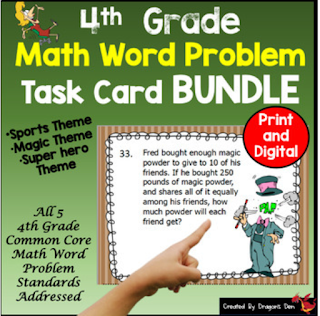
If you teach fourth grade (or need review for fifth graders) you might be interested in my 4th grade math word problem bundle. Each resource is also available separately, but together they cover ALL Common Core standards for word problems in 4th grade.